
Top 10 Things to Do in Kathmandu | The Valley Beats the City
Kathmandu the city is dusty, dense and loud. Kathmandu the valley holds three medieval royal cities within an hour of each other, and almost every trekker walks straight past all of it on the way to a mountain.
The valley, not the city
Kathmandu the city is a lot: dense, dusty, loud, and in the dry season the air is genuinely poor. Visitors arrive expecting mountain serenity and find a working South Asian capital in a bowl.
Kathmandu the valley is a different proposition, and it is the reason to give this place three days rather than one.
Within an hour of the centre sit two other medieval royal cities, Bhaktapur and Patan, each with its own Durbar Square, each the seat of a separate kingdom that spent centuries competing with the other two by building things. Three rival courts, three sets of palaces and temples, all in a valley you can cross in a morning.
There is nothing else quite like it in Asia, and almost every trekker walks straight past it. Ask us about a Nepal itinerary.
The ten
1. Bhaktapur, and stay the night
The best of the three and the one to give a full day.
Largely traffic-free inside the old walls, and it is a functioning medieval city rather than a preserved one: potters working in the pottery square, woodcarving that is genuinely the finest in Nepal, a five-tiered pagoda that will stop you where you stand.
Stay the night if you can. The town after the day visitors leave is an experience most people never have, and it is the single best suggestion on this page. Compare Bhaktapur tours on Viator.
2. Patan Durbar Square
Across the river and effectively part of the urban area now.
The densest and arguably loveliest of the three squares, a superb museum in an old palace, and a courtyard-based old town where you can be genuinely lost and genuinely calm at the same time.
3. Boudhanath at dusk
One of the largest stupas anywhere: a white dome the size of a football ground with painted eyes on top, ringed by monasteries and shops and cafes.
At dusk, hundreds of people walk clockwise around it, spinning prayer wheels, in a slow current that has been running for centuries. It is the calmest crowded place you will ever stand in.
Order something on a rooftop and watch the circling.
4. Pashupatinath, quietly
A Hindu temple complex on the Bagmati river, and it is where cremations happen, openly, on ghats beside the water, every day.
This is not a spectacle arranged for anyone. Families are grieving. Non-Hindus cannot enter the main temple and view the ghats from across the river.
Go quietly. Do not photograph the families. Understand that you are a guest at something private happening in public. It is one of the most affecting places in South Asia and the most requiring of manners.
5. Kathmandu's own Durbar Square
The busiest and the most damaged of the three. The earthquake did real harm here and restoration is ongoing and will be for years.
Still worth an afternoon, particularly for the Kumari Ghar, home of the living goddess: a young girl selected as an incarnation, who appears at a window.
6. Swayambhunath, early
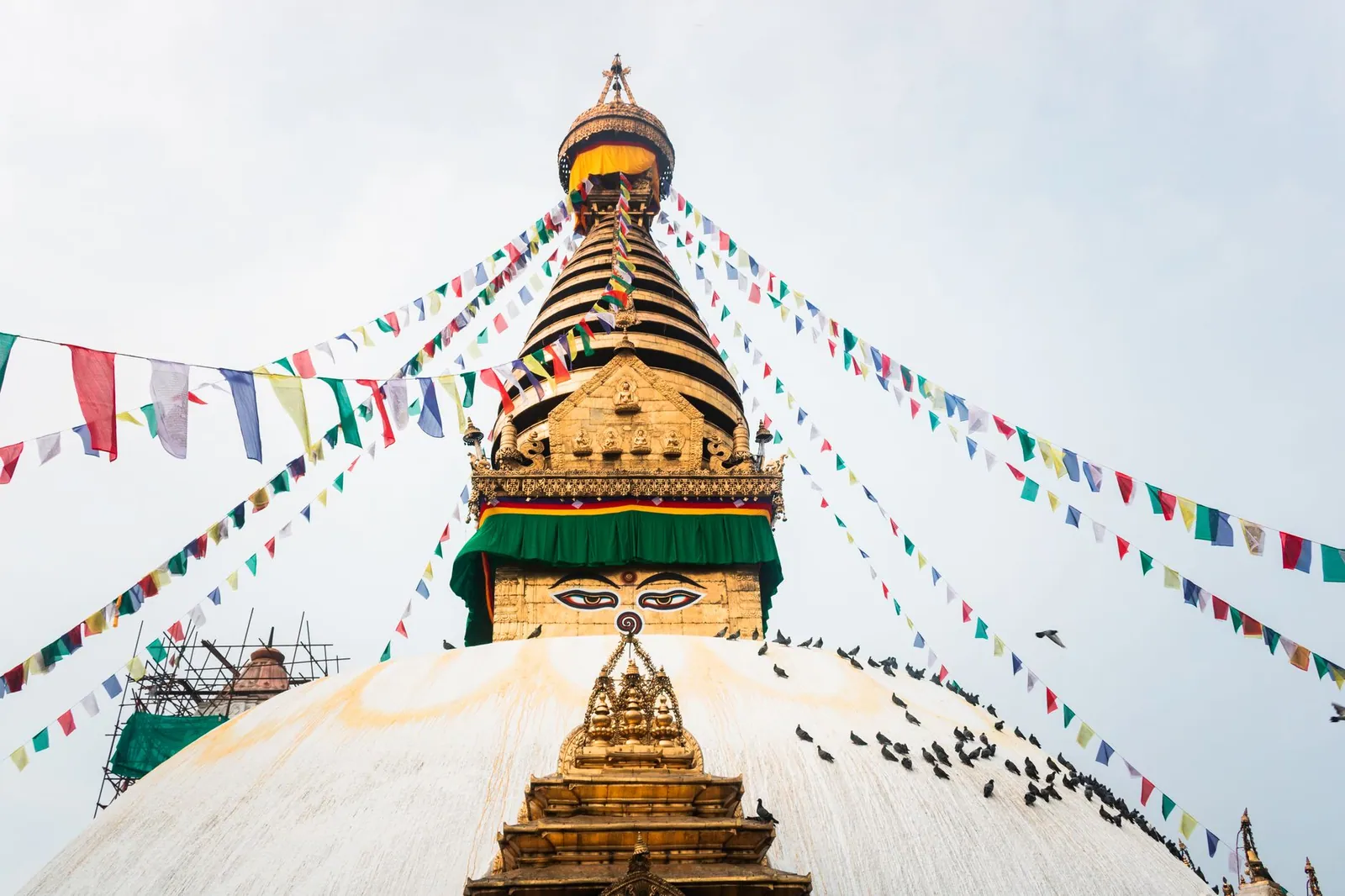
The hilltop stupa with the monkeys and the long staircase. It gives you the whole valley from above and it is best at first light.
7. A Newari meal in Patan
The thing almost no visitor tries and the best food experience in this valley.
Newari is the cuisine of the valley's own people: spicier, stranger and more interesting than standard Nepali fare, involving cuts of buffalo you may prefer not to identify.
Ask for it specifically. Nobody will offer it to you.
8. Dal bhat, and understanding why
The national meal and the engine of the country: rice, lentil soup, a vegetable curry, a pickle, and refills of everything until you stop.
Trekkers eat it twice a day for a fortnight and do not tire of it, which is a genuine surprise and the reason you will hear "dal bhat power, twenty-four hour" on every trail.
9. The mountain flight
An early morning scenic flight along the Himalaya, about an hour, everyone getting a window seat by rotation, and Everest visible from the aircraft.
It is weather-dependent and frequently postponed. Book it early in your stay so there are days left to try again. When it goes, it is one of the great hours in travel. Find mountain flights on Klook.
10. A Himalayan dawn without a trek
Nagarkot on the valley rim, or Dhulikhel. Both are an easy drive and both give you sunrise over the Himalaya without walking anywhere.
If you are not trekking, this is how you see the mountains.
You cannot see Everest from Kathmandu
Worth saying plainly, because it disappoints people weekly.
Kathmandu sits in a valley at moderate altitude with hills all around it. On a clear morning, from the valley rim or a rooftop in the right season, you can see snow peaks.
You cannot see Everest, which is a long way east and behind a great deal of other mountain.
The mountain flight above is what shows you the rest, and the hill towns are the alternative. Our Kathmandu travel guide covers both.
If you are trekking, two rules
These cause more ruined Nepal trips than everything else combined, and they belong on every page we write about this country.
Never fly to Lukla the day you arrive, or the day before you leave.
Mountain flights are weather-dependent in a way Australians have no reference point for. They are cancelled and delayed regularly, sometimes for days, and the backlog compounds. That is normal rather than a failure.
So: at least one night in Kathmandu before the mountain flight, and several buffer days between coming off the trail and your international flight home. Trekkers who leave a single day of margin are the ones we get calls from.
Your trekking baggage limit is not your airline baggage limit.
Your international ticket allowed 30kg or more. The flight to Lukla allows around 10kg plus a small carry-on, and it is enforced, because the aircraft are small and the runway is famously short and sloped.
Your Kathmandu hotel stores the excess while you are on the mountain, at no real cost and with no fuss, because they do it every day of the season. Pack knowing you will split the bag.
Our flights to Nepal page covers the international side.
The seasons decide everything here
October and November is the season: post-monsoon air, the clearest mountain views of the year, and the main trekking window.
March to May is the second season: warmer, hazier, and the rhododendron forests are in flower.
June to September is monsoon: the mountains are behind cloud, the trails are wet, the leeches are real and the flights are unreliable. The valley is green and cheap and it is not the trip you are imagining.
December to February is cold and often beautifully clear, the high passes close, and the lower treks are entirely doable for anyone who can handle a genuinely cold morning.
Booking notes
Prices shown by our partners are live and in your choice of currency, most activities confirm instantly, and free cancellation windows are stated on each listing. Most of this list needs nothing booked: the squares, the stupas and the streets are simply there.
The exceptions are the mountain flight, worth booking early in your stay so you can try again, and anything on the trekking side, which needs the buffer days built in from the start rather than added later.
The carriers serving Kathmandu from each hub change more often than on almost any route we book, so we confirm what is genuinely flying on your dates. Get a free Nepal quote.